Welcome to
Lice Intervention & Care Experts
🪻Explore our professional lice services and products, thoughtfully designed to provide effective treatment, expert guidance, and complete peace of mind for your family. →
Gentle Care • Proven Results • Peace of Mind
🌿
Head Lice Screenings
🌿
FloSonix Heated Air Treatment
🌿
Full Comb Out
🌿
Gentle Care • Proven Results • Peace of Mind 🌿 Head Lice Screenings 🌿 FloSonix Heated Air Treatment 🌿 Full Comb Out 🌿
Your Questions, Answered
-
Head lice are tiny insects that live on the human scalp and feed on small amounts of blood. They are common, especially among children, and having head lice does not mean someone is dirty or has poor hygiene.
Lice do not discriminate—they can live in clean hair, dirty hair, short hair, long hair, thick hair, or fine hair. Anyone can get head lice.
Adult head lice are about the size of a sesame seed. They are usually grayish, tan, or brown and have six legs with tiny claws that allow them to grip the hair and move close to the scalp. They cannot fly or jump—they crawl.
Most importantly, head lice do not spread disease. They are not dangerous, but they can be an irritating and frustrating nuisance that causes itching, discomfort, and stress until the infestation is properly addressed.
-
Head lice are most commonly spread through direct, prolonged head-to-head contact. When two people's hair touches, a louse can crawl from one person's hair to another.
This can happen during:
Playing together
Sleepovers
Hugging
Taking pictures together
Sports or activities where heads are close
Sitting or lying close together
Sharing a bed
Lice can occasionally be transferred through recently shared items that have come into contact with someone's hair, such as hats, brushes, combs, hair accessories, or pillows. However, head-to-head contact is the primary way lice spread.
Human head lice only live on humans and cannot live on or infest your pets. Dogs, cats, guinea pigs, rabbits, hamsters, ferrets, birds, and other household pets do not spread human head lice. While animals can have their own species-specific lice, these are different from human head lice and are not a source of human head-lice infestations. There is no need to treat your pets when someone in your home has head lice.
-
Some people experience no symptoms at all, especially when they have a new infestation.
Others may experience:
An itchy scalp
A crawling or tickling sensation
Irritation or a feeling that something is moving in the hair
Scratching
Redness or small bumps from scratching
Difficulty sleeping because itching may be worse at night
Itching is caused primarily by the body's reaction to the louse's bites and saliva. Itching alone does not prove that someone has lice.
-
According to the CDC, head lice can be treated with an appropriate over-the-counter or prescription lice treatment, following the product directions carefully. Wet-combing with a fine-toothed lice comb can also help remove lice and nits. Everyone in the household should be professionally checked, but only those with live lice should generally be treated. Extensive cleaning of the home is not necessary.
Unfortunately, head lice have developed resistance to some of the active ingredients found in commonly used over-the-counter and prescription treatments. Much like other organisms that develop resistance over time, certain lice populations have adapted to survive chemicals that were once effective at eliminating them. This can make treatment more challenging and may contribute to persistent or recurring infestations.
Lice Intervention & Care Experts provides professional lice checks and removal to help families safely and thoroughly address an infestation.
THE STEPS TO RID YOUR FAMILY OF LICE
STEP 1 - Confirm that live lice are present. A thorough head check can help distinguish active lice from dandruff or old nits.
Treatment may include professional lice and nit removal, careful combing, or an appropriate lice treatment product. Because nits are firmly attached to the hair, thorough removal and follow-up checks are important.
STEP 2 - If lice are found, check household members and close contacts, but only treat those with an active infestation.
Extensive house cleaning is not necessary. Focus on recently used items that have had close contact with the person's head, such as pillowcases, bedding, brushes, and hats. (See question - “Do I Need to Clean My Entire House After Finding Lice”?)
Need help? L.I.C.E. — Lice Intervention & Care Experts provides professional lice checks and removal services in Blue Bell and surrounding areas. We are here to make the process simple, thorough, and stress-free.
Feel free to reach out 215.804.9223
L.I.C.E. — Gentle Care. Proven Results. Peace of Mind.
-
No! Extensive house cleaning is not necessary. Head lice spend most of their time on the human scalp, and lice that fall off the head do not survive long without feeding.
Heat is effective at killing lice and nits. Items that have recently been in contact with the affected person's head can be washed in hot water (at least 130°F) and dried using high heat. Combs and brushes can also be soaked in water at least 130°F for 5–10 minutes.
You do not need to wash every item in your home or disinfect your furniture. Instead, focus on practical cleaning: vacuum floors, sofas, chairs, and other areas where the person has recently rested, and consider using a sticky lint roller on upholstered furniture to help pick up stray hairs or anything that may have fallen from the head. The CDC specifically recommends vacuuming furniture and notes that the risk of getting lice from furniture or carpeting is very small.
The most important place to focus your attention is the head—not the house. Thoroughly treating and removing the lice and nits is the key to getting rid of the infestation.
-
Yes — African American people absolutely can get head lice. They are not immune to lice.
What is true is that head lice tend to be less common among Black/African American children in the U.S. than among some other populations. Research suggests this is related partly to differences in hair structure, particularly tightly curled/coily hair, because the claws of common head lice are better adapted to grasping certain hair shapes. CDC Stacks
However, “less common” does not mean “can't happen.” Studies have documented head-lice infestations among African American children, including one U.S. school study that found a 15% infestation rate among African American children. PubMed
“Head lice can affect anyone, regardless of race or hair type. While lice may be less common in tightly coiled hair, they can still occur and should be properly screened when exposure or symptoms are present.”

Watch this short video for easy directions to our suite, conveniently located in the Blue Bell Medical Building, directly across from the Wissahickon Valley Public Library.
Visit Us… conveniently located in Blue Bell!
Located in the heart of Blue Bell, our private, welcoming office offers a comfortable, family-friendly environment where expert care meets exceptional service. From the moment you arrive, our team is dedicated to making your experience as stress-free as possible with personalized attention and evidence-based treatment you can trust.
Visit us at:
L.I.C.E. – Lice Intervention & Care Experts
653 Skippack Pike, Suite 203
Blue Bell, PA 19422
Experience Gentle Care. Proven Results. Peace of Mind. at a office designed with your family's comfort and confidence in mind.
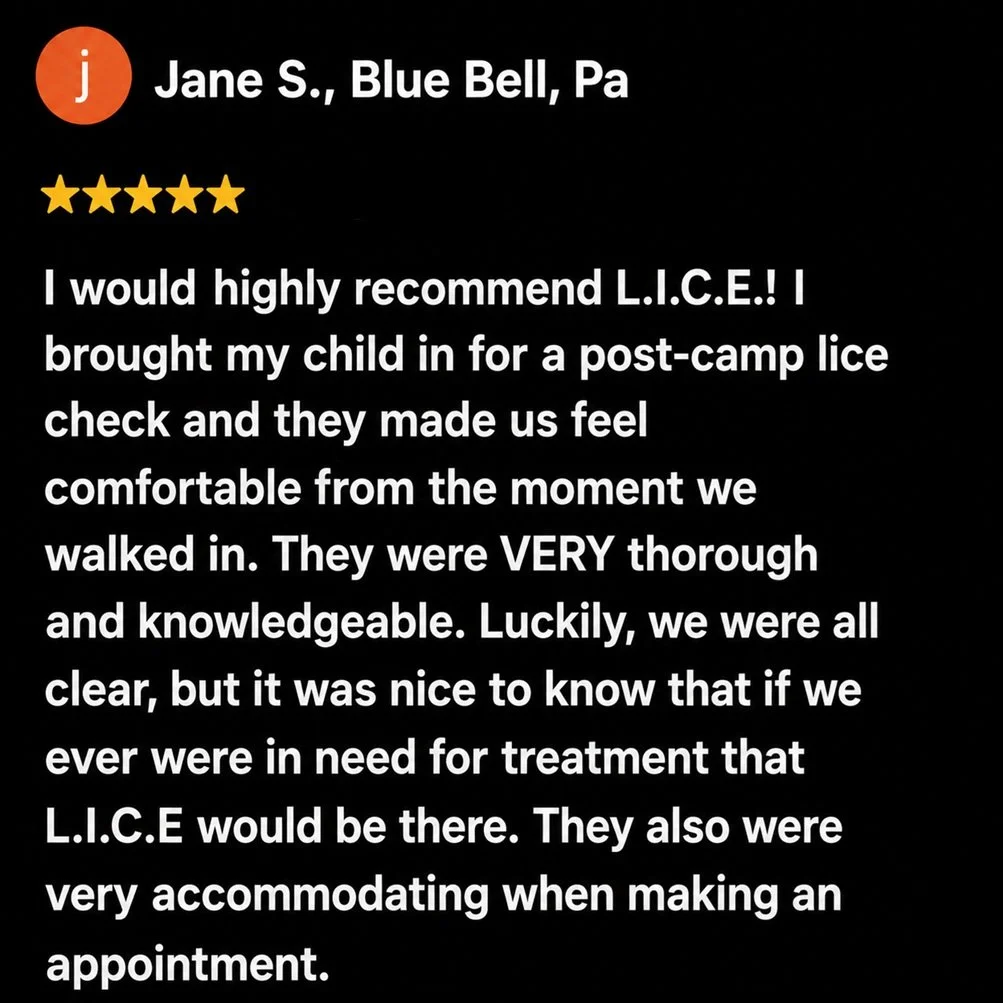
Customer Reviews